Tuesday, October 26, 2010

Concrete Curing Time

At 50°F (10°C)

Percentage design strength required
Type cement used in mix

        I                   II                 III
50%

6

9

3
65%

11

14

5
85%

21

28

16
95%
29
35
26

At 70°F (21°C) Days


Percentage design strength required
Type cement used in mix

        I                   II                 III
50%

6

9

3
65%

11

14

5
85%

21

28

16
95%
29
35
26

Monday, October 25, 2010

Curing of Concrete-Curing Procedures

To attain design strength, curing is a crucial part of the cast-in-place concrete process in order that the proper amount of moisture content and ambient temperature be maintained immediately following the placement of the concrete. The optimum curing cycle will take into account the prevention or replenishment of moisture content from the concrete and the maintenance of a favorable temperature for a specific period of time. During winter months, temporary protection and heat is required in conjunction with the curing process, and during summer months, moisture replenishment becomes an integral part of the curing process.
1. Apply a membrane-curing compound-eithe r by spraying or rolling on the surface immediately after the troweling process on slabs has ceased, or on walls, columns, beams, after the forms have been removed.
2. Curing by water in other than cold-weather conditions is acceptable, as long as it is continuous.
3. Waterproof paper, applied directly over the concrete surface after it has received a spray of water, is often effective.
4. Damp burlap, free of foreign substances that could leach out and stain the concrete, is also a proven curing procedure, as long as the burlap is kept moist.
5. Polyethylene sheets can be used as a blanket in much the same manner as waterproof paper, as long as its edges are lapped and sealed properly.
6. Damp sand or straw is also used on occasion, when nothing else is available. These materials must also be sprayed from time to time to maintain the moisture content.
The length of curing depends upon a number of factors, including the type of cement used and am bient temperatures. The following can be used as a guideline to determine the length of curing time.

Recommended Slumps

The Portland Cement Association recomumends the following slumps:

Component

Max. slump (inches)
Min. slump (inches)
Footings (reinforced or not)

3
1
Foundation walls

3
1
Substructure walls

3
1
Caissons

3
1
Beams and reinforced walls

4
1
Building columns

4
1
Pavements and slabs

3
1
Mass concrete
2
1


Slump Test

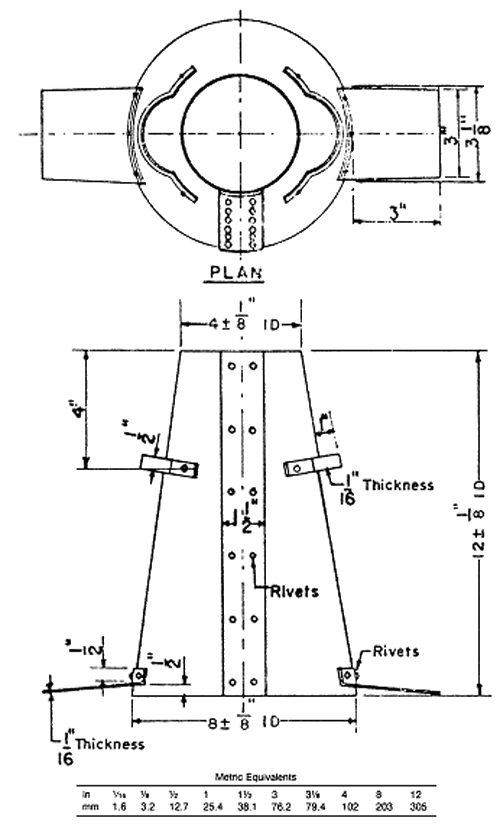
Slump, as it relates to concrete, is a measure of consistency equal to the decrease in height, measured to the nearest
1⁄4 inch (6 mm) of the molded mass immediately after it has been removed from this molded mass created by the “slump cone.”
The mold is in the form of a frustum (part of a solid cone intersected by the use of parallel lines) 12 inches (2.5 cm) high, with a base diameter of 8 inches (2 cm) and a top diameter of 4 inches (1 cm).
This mold (slump cone) is filled with freshly mixed concrete in three layers, each being rodded with a 5⁄8-inch (15.9 mm) bullet-shaped rod 25 times. When the mold has been filled, the top is struck off and the mold is lifted. The amount by which the mass settles after mold removal is referred to as slump. A small slump is an indication of a very stiff mix, and a very large slump is indicative of a verywet consistency.
Recommended slumps are:

Type of construction

Maximum slump (inches)
Minimum slump (inches)
Reinforced walls/footings

3 (76.2 mm)

1 (25.4 mm)
Caissons, substructure walls

3
1
Beams, reinforced walls

4 (102 mm)

1
Building columns

4
1
Pavements, slabs

3
1
Mass concrete
2 (50.8 mm)
1

 Rule of thumb: To raise the slump 1 inch (25.4 mm), add 10 pounds of water for each cubic yard of concrete. (One gallon of water equals 8.33 pounds.)

Slump Cone 


Guideline - Mixing Small Batches of Concrete

by Weight


Max. size aggregate
Cement (Ib/kg)

Wet-fine aggregate (Ib/kg)

Wet-coarse aggregate (Ib/kg)

Water (Ib/kg)

3/8 " (9.52 mm)
29 Ib (13.15 kg)

59 Ib (26.76 kg)

46 Ib (20.87 kg)

11 Ib (4.99 kg)

½ " (12.6 mm)

27 Ib (12.25 kg)

53 Ib (24.04 kg)

55 Ib (24.95 kg)

11 Ib (4.99 kg)

¾ " (19.05 mm)

25 Ib (1 1 .34 kg)

47 Ib (21.32 kg)

65 Ib (29.66 kg)

10lb (4.54 kg)

1" (25.39 mm)

24 Ib (10.89 kg)

45 Ib (20.41 kg)

70 Ib (31.75 kg)

10 Ib (4.54 kg)

1/2" (37.99 mm)
23 Ib (10.43 kg)
43 Ib (19.50 kg)
75 Ib (34.02 kg)
3)
9 Ib (4.08 kg)


by Volume


Max. size aggregate

Cement
Wet-fine aggregate
Wet-coarse aggregate
Water
3/8 " (9.52 mm)

1
2 ½
1 ½
½
½ " (12.6 mm)

1
2 ½
2
½
¾ " (19.05 mm)

1
2 ½
2 ½
½
1" (25.39 mm)

1
2 ½
2 ¾
½
1 ½ “ (37.99 mm)
1
2 ½
3
½

Sunday, October 24, 2010

Chloride Content in Mixing Water.

Excessive chloride ions in mixing water can contribute to accelerated reinforcing-steel corrosion and should be a concern when evaluating a mix design. Maximum water-soluble chloride ions, in various forms of concrete (as a percentage), should not exceed the following:
  • Prestressed concrete 0.06%
  • Reinforced concrete exposed to chloride in service (e.g., garbage slab) 0.15%
  • Reinforced concrete that will be dry and/or protected from moisture infiltration 1.00%
  • Other reinforced concrete 0.30%

Admixtures

Although concrete is an extremely durable product, it faces deterioration from various sources:
Chemical attack, permeation by water and/or gases from external sources, cracking because of the chemical reaction (known as heat of hydration), corrosion of steel reinforcement, freeze/thaw cycles, and abrasion. Much of the deterioration caused by these internal and external factors can be drastically delayed by the addition of a chemical admixture to the ready-mix concrete.
Admixtures are chemicals developed to make it easier for a contractor to produce a high-quality concrete product. Some admixtures retard curing, some accelerate it; some create millions of microscopic bubbles in the mixture; others allow a substantial reduction in water content, but still permit the concrete to flow like thick pea soup.

  • Water-reducing admixtures Improve strength, durability, workability of concrete. Available in normal range and high range.
  • High-range water-reducing admixture Also known as superplasticizer, it allows up to 30% reduction in water content with no loss of ultimate strength, but it creates increased flowability. It is often required where reinforcing steel is placed very close together in intricate forms.
  • Accelerating admixtures They accelerate the set time of concrete, thereby reducing the protection time in cold weather, allowing for earlier stripping of forms. Accelerating admixtures are available in both chloride- and nonchloride-containing forms. Nonchloride is required if concrete is to be in contact with metal and corrosion is to be avoided.
  • Retarder admixtures Retards the setting time, a desirable quality during very hot weather.
  • Air-entraining admixtures Creates millions of microscopic bubbles in the cured concrete, allowing for expansion of permeated water, which freezes and is allowed to expand into these tiny bubbles, thereby resisting hydraulic pressures caused by the formation of ice.
  • Fly ash When added to the concrete mixture, it creates a more dense end product, making the concrete extremely impermeable to water, which affords more protection to steel reinforcement contained in the pour. The addition of fly ash can increase ultimate strength to as much as 6500 psi (44.8 MPa), in the process, making the concrete more resistant to abrasion.
  • Silica fume Also known as microsilica, it consists of 90 to 97% silicon dioxide, containing various amounts of carbon that are spherical in size and average about 0.15 micron in size. These extremely fine particles disperse into the spaces around the cement grains and create a uniform dense microstructure that produces concrete with ultra-high compressive strengths, in the nature of 12,000 (82.73 MPa) to 17,000 psi (117.20 MPa).
  • Multifilament or fibrillated fibers This material is not a chemical admixture per se, but several manufacturers of concrete chemical additives also sell containers of finely chopped synthetic fibers, generally polypropylene, which, when added to the ready-mix concrete, serve as secondary reinforcement and prevent cracks.

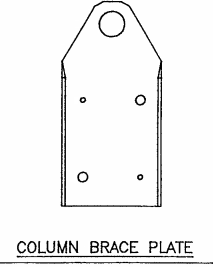
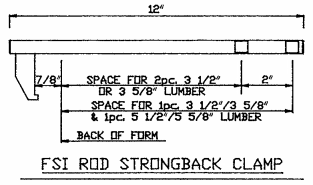
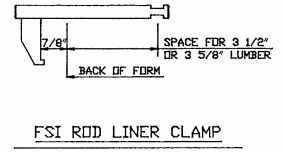
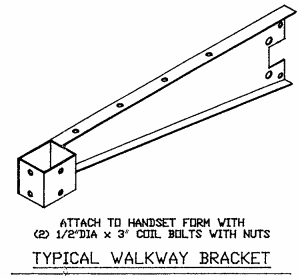
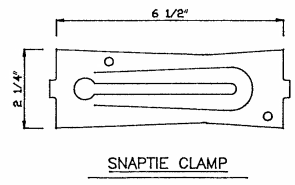
Various Clamps, Ties, Keys, and Wedges


Copyright@2010 INGENIERÍA ECONÓMICA